APA Statement on the War in Ukraine

WASHINGTON, D.C., March 2, 2022 – Today, the American Psychiatric Association CEO and Medical Director Saul Levin, M.D., M.P.A., and Chair of APA Committee on the Psychiatric Dimensions of Disaster Joshua Morganstein, M.D., offered the following APA statement and resources in response to the War in Ukraine:

..

The APA supports the care of all immigrants, refugees, displaced persons, and all within Ukraine with dignity and respect, and strongly advocates for the provision of evidence-based and culturally-competent mental health support for those affected through early interventions to mitigate the distress and the treatment of mental health conditions that may arise.”

Resources:

APA Statement and Resources on the Mental Health Impact of the War in Ukraine (psychiatry.org)

Joseph (Joe) E. Thornton, M.D., DFAPA

Drugs.com overview of weight loss medications

FDA-Approved Weight Loss Drugs: Can They Help You?

Joseph (Joe) E. Thornton, M.D., DFAPA
Adjunct Clinical Associate Professor, Psychiatry
University of Florida College of Medicine
joethornton@ufl.edu

CONFIDENTIALITY NOTIFICATION: Please be advised! This e-mail message, including any attachments, has been created explicitly for the sole use of the intended recipient(s) and may contain confidential and privileged information. The materials in this message are private and may contain Protected Healthcare Information or other information of a sensitive nature. If you are not the intended recipient, be advised that any unauthorized use, disclosure, copying or the taking of any action in reliance on the contents of this information is strictly prohibited. If you have received this email in error, please immediately notify the sender via telephone or return mail. Any unauthorized review, use, disclosure, or distribution of such information is prohibited and will be upheld under the discretion of Federal and State law. If you have received this e-mail message in error and are not an intended recipient, please contact the sender via reply e-mail or phone and destroy all copies of the original message. Pursuant to ‘ FS 766.101, FS 395.0193, FS 395.0197, FS 766.1016 and other Statutes, this document is privileged and confidential. It is not subject to discovery. Please do NOT copy or release.

NIH website on weight management, including table of medications

https://www.google.com/url?sa=t&rct=j&q=&esrc=s&source=web&cd=&cad=rja&uact=8&ved=2ahUKEwi8tqvF1Kr2AhWqQTABHUiuBOYQFnoECAYQAQ&url=https%3A%2F%2Fwww.niddk.nih.gov%2Fhealth-information%2Fweight-management%2Fprescription-medications-treat-overweight-obesity&usg=AOvVaw0it2lzmOGFSzxpaGNWpADh

Joseph (Joe) E. Thornton, M.D., DFAPA

Semaglutide JAMA 2022

Semaglutide JAMA 2022

Effect of Weekly Subcutaneous Semaglutide vs Daily Liraglutide on Body Weight in Adults With Overweight or Obesity Without Diabetes: The STEP 8 Randomized Clinical Trial | Lifestyle Behaviors | JAMA | JAMA Network

Rubino DM, Greenway FL, Khalid U, et al. Effect of Weekly Subcutaneous Semaglutide vs Daily Liraglutide on Body Weight in Adults With Overweight or Obesity Without Diabetes: The STEP 8 Randomized Clinical Trial. JAMA. 2022;327(2):138–150. doi:10.1001/jama.2021.23619

Key Points

Question Among adults with overweight or obesity without diabetes, what is the effect of once-weekly subcutaneous semaglutide, 2.4 mg, vs once-daily subcutaneous liraglutide, 3.0 mg, on weight loss when each is added to counseling for diet and physical activity?

Findings In this randomized clinical trial that included 338 participants, mean body weight change from baseline to 68 weeks was –15.8% with semaglutide vs –6.4% with liraglutide, a statistically significant difference.

Meaning Among adults with overweight or obesity without diabetes, once-weekly subcutaneous semaglutide, compared with once-daily subcutaneous liraglutide, added to counseling for diet and physical activity resulted in significantly greater weight loss at 68 weeks.

Joseph (Joe) E. Thornton, M.D., DFAPA

Semaglutide Medscape article in 2020

Semaglutide Medscape article in 2020

Major Breakthrough in Weight Loss With Semaglutide? (medscape.com)

In a phase 3 trial where all participants received intensive behavior therapy, investigational 2.4-mg once-weekly subcutaneous semaglutide (Novo Nordisk) resulted in a 10.3% greater average weight loss than placebo over a period of 68 weeks.

If approved, this medication could be a "potential major breakthrough" in obesity management, the investigators suggest. But other experts urge caution, as cost and uptake are important considerations.

Perhaps even more impressive was the finding that 75% of patients lost 10% or more of baseline body weight," said Wadden, of the Department of Psychiatry, Perelman School of Medicine, University of Pennsylvania.

Moreover, in this trial of semaglutide, a glucagon-like peptide-1 (GLP-1) receptor agonist that is approved for treating type 2 diabetes at a weekly subcutaneous dose of 1 mg (Ozempic, Novo Nordisk), but is being investigated at the higher dose for weight loss — 55% of patients lost ≥ 15% of their initial weight, and 36% lost ≥ 20% of their initial weight. ….

In the discussion that followed the virtual presentation, one attendee asked about potential weight regain if a patient stopped taking the drug. Based on experience with another subcutaneous injectable GLP-1 receptor agonist, liraglutide (Saxenda, Novo Nordisk), already approved for obesity, it may be that taking medicine for chronic overweight may become like taking a statin for elevated cholesterol, said Wadden.

Novo Nordisk has now completed the four trials in the STEP (Semaglutide Treatment Effect in People With Obesity) global phase 3 clinical development program, and plans to file applications with the US Food and Drug Administration (FDA) later this year and with the European Medicines Agency in early 2021 for review of semaglutide 2.4 mg for weight management. ….

During the first 8 weeks, participants were provided with a 1000-1200 kcal/day meal replacement diet that included liquid shakes, meal bars, and prepared entrees designed to facilitate a large initial weight loss.

They then transitioned to a diet of conventional foods (of their choosing), with a goal of 1200-1800 kcal/day based on body weight.

The physical activity goal was 100 minutes/week of walking or other aerobic activity in the first month, building up to 200 minutes/week by month 6. …

As well as being approved as a weekly subcutaneous injectable treatment for type 2 diabetes, semaglutide is also approved as an once-daily oral agent for the same indication (Rybelsus, Novo Nordisk) in doses of 7 mg and 14 mg to improve glycemic control along with diet and exercise. It is the first GLP-1 agonist available in tablet form.

Joseph (Joe) E. Thornton, M.D., DFAPA

Additional Medicaid CBTi/Sleep Service Updates

Joseph (Joe) E. Thornton, M.D., DFAPA
Adjunct Clinical Associate Professor, Psychiatry
University of Florida College of Medicine
joethornton@ufl.edu

CONFIDENTIALITY NOTIFICATION: Please be advised! This e-mail message, including any attachments, has been created explicitly for the sole use of the intended recipient(s) and may contain confidential and privileged information. The materials in this message are private and may contain Protected Healthcare Information or other information of a sensitive nature. If you are not the intended recipient, be advised that any unauthorized use, disclosure, copying or the taking of any action in reliance on the contents of this information is strictly prohibited. If you have received this email in error, please immediately notify the sender via telephone or return mail. Any unauthorized review, use, disclosure, or distribution of such information is prohibited and will be upheld under the discretion of Federal and State law. If you have received this e-mail message in error and are not an intended recipient, please contact the sender via reply e-mail or phone and destroy all copies of the original message. Pursuant to ‘ FS 766.101, FS 395.0193, FS 395.0197, FS 766.1016 and other Statutes, this document is privileged and confidential. It is not subject to discovery. Please do NOT copy or release.

Sublingual Dexmedetomidine as a Potential New Treatment for Agitation

Sublingual Dexmedetomidine as a Potential New Treatment for Agitation

John K. Hsiao, MD1

Author Affiliations Article Information

JAMA. 2022;327(8):723-725. doi:10.1001/jama.2021.21313

An out-of-control, agitated, possibly aggressive patient in a medical setting is a crisis demanding swift and safe resolution. Traditionally, behavioral agitation, often due to psychosis, was managed by psychiatry, particularly when physical restraints were the primary options.1 After chlorpromazine’s calming, neuroleptic properties were recognized in the 1950s,2 pharmacological management became possible. Additional first-generation neuroleptic antipsychotics were introduced through the 1960s. In subsequent decades, the pharmaceutical industry developed the second-generation antipsychotics and benzodiazepines now used to treat agitation. ..

The study by Preskorn et al in this issue of JAMA both introduces and provides evidence to support a novel, potentially important addition to the armamentarium for managing behavioral agitation. Whether film sublingual dexmedetomidine receives regulatory approval and for which indications remains to be determined. Nevertheless, even if this form of sublingual dexmedetomidine is never marketed (or its cost is prohibitive), the results from this clinical trial call attention to novel-use cases for dexmedetomidine outside the critical care setting and beyond sedation for procedures. .

Sublingual Dexmedetomidine as a Potential New Treatment for Agitation | Emergency Medicine | JAMA | JAMA Network

Joseph (Joe) E. Thornton, M.D., DFAPA

Antipsychotics for maintenance therapy of scizophrenia

16bf102fc319d621a456d9f821071253_normal.jpeg spacer.png
The Lancet
⁦‪@TheLancet‬⁩
logo_twitter-1497383721365.png
spacer_464x1-1582829598167.png
This study suggests choice of antipsychotic for maintenance treatment of adults with schizophrenia should be guided mainly by tolerability; authors report no clear differences between antipsychotics for relapse prevention. hubs.li/Q0156dN20 pic.twitter.com/2MGZz34Ven
3/1/22, 12:04 PM

Joseph (Joe) E. Thornton, M.D., DFAPA

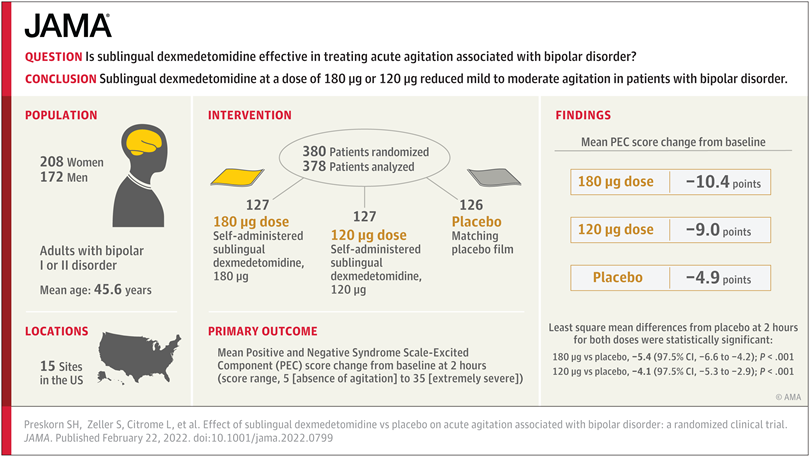
Sublingual dexmedetomidine for treatment of agitation in bipolar disorder.

Randomized Placebo controlled trial reported in JAMA demonstrated effectiveness over placebo at 2 hours. The medication was well tolerated.
Not clear if the clinical effect is sufficient.

Preskorn SH, Zeller S, Citrome L, et al. Effect of Sublingual Dexmedetomidine vs Placebo on Acute Agitation Associated With Bipolar Disorder: A Randomized Clinical Trial. JAMA. 2022;327(8):727–736. doi:10.1001/jama.2022.0799

Joseph (Joe) E. Thornton, M.D., DFAPA
Alzheimers disease like signaling in the brains of COVID-19 patients

Reiken et al from Columbia University extrapolate esoteric data from the neurochemistry of older patients with Alzheimer disease and finds similarities in this study neurocognitively impaired patients who died from COVID-19.

The main argument I find to dispel that this is simply a finding from 2 separate but very common comorbid conditions, is that the patients with COVID-19 had the pathological findings in the cerebellum which is not a location impacted by Alzheimer’s disease. They then promote their findings by stating IF this finding is true (increased activity on the ryanodine receptor) then MAYBE there is a POTENTIAL target for treatment.

Figure 4 might be of interest

JT

Joseph (Joe) E. Thornton, M.D., DFAPA
Reiken – Alzheimer s$B!>(Blike signaling in brains of COVID$B!>(B19 patients.pdf