Neuroleptic Malignant Syndrome

Here is an overview of NMS.

Learning objectives

-Recognize the tetrad of sx of NMS during patient care

-Diagnose NMS in practice

-Make recommendations to the team when suspecting NMS

Definition

  • Neurologic emergency
  • Syndrome associated with dopamine-blocking medications (especially antipsychotics)
    • Can also be from removal of dopaminergic med (carbidopa-levodopa)
  • Classic tetrad (diagnostic criteria):
    • Mental status change
      • Confusion > psychosis, may progress to stupor/coma
      • Can see catatonia/mutism
    • Rigidity
      • Lead-pipe
    • Hyperthermia
      • Usually >38C, sometimes >40C
    • Autonomic instability
      • Tachycardia, labile/high BP, tachypnea, diaphoresis
  • NOTE: Some cases don’t have all of these criteria. Consider NMS when ANY 2 of the tetrad occur in the setting of an antidopamine drug.
  • Sx usually evolve over 1-3 days after:
    • High doses, rapid dose escalation, switching agents, parenteral administration
  • Risk factors:
    • Lithium or other psychotropics, depot formulations, substance use, neurologic disease, acute medical illness, dehydration, infection, surgery

Typical Labs

  • Leukocytosis (10-40K)
  • Elevated LDH, ALP, LFT
  • Electrolyte abnormalities
    • Hypocalcemia, hypomagnesemia, hypo/hypernatremia, hyperkalemia, metabolic acidosis
  • Myoglobinuria from rhabdomyolysis
  • Low serum iron common
  • Elevated CK (1-10,000, can be much higher in severe cases)

Evaluation

  • Diagnosis is confirmed by history (exposure to offending drug) and presence of supportive features. There is no single diagnostic test.
  • Workup is to:
    • Exclude other causes
    • Detect complications
  • There actually are DSM-TR criteria apparently but no single scoring system used in practice

DDx

  • Serotonin syndrome
    • More hyperreflexia, clonus, GI symptoms
  • Malignant hyperthermia
    • Anesthetic, succinylcholine exposure
  • Malignant catatonia
  • Intrathecal baclofen withdrawal
  • Anticholinergic toxicity
  • Stimulant intoxication
  • Other serious conditions:
    • CNS infection
    • Sepsis
    • Seizures
    • Heat stroke
  • Tetanus
  • Alcohol withdrawal
  • Thyrotoxicosis
  • Pheochromocytoma
  • Autoimmune encephalitis
  • Acute porphyria

Management

  • Stop offending drug immediately or restart dopaminergic drug
  • Often requires ICU care
  • Need to:
    • Maintain cardiorespiratory stability, give IV fluids, treat rhabdomyolysis-related kidney injury, control hyperthermia, control severe HTN, provide DVT prophylaxis
  • Meds that can be used:
    • Lorazepam or other benzos
      • Lorazepam 1-2mg IM or IV q4-6h
      • Diazepam 10mg IV q8h
    • Dantrolene: 1-2.5 mg/kg IV, can repeat up to 10 mg/kg/day
  • Bromocriptine: 2.5mg via NG tube q6-8h, titrate up to 40mg/day 
  • Amantadine: 100mg PO or via gastric tube initially, titrate up to 200mg q12h
  • ECT
    • Can be considered in refractory cases or when psychotropic tx is needed but can’t use antipsychotics
    • Limited evidence
    • Has safety risks, including cardiovascular complications

Possible complications

  • Dehydration, electrolyte abnormalities, AKI, cardiac arrhythmias, MI, stress cardiomyopathy, respiratory failure, aspiration pneumonia, pulmonary embolism, VTE, sepsis

Prognosis

  • Most cases resolve within 2 weeks, mean 4-11 days
  • Longer illness in depot antipsychotics or structural brain disease
  • Mortality: 5-10%, used to be higher
    • Death from systemic complications

Restarting antipsychotics

  • There is a risk of recurrence, but unknown degree of risk
  • Wait at least 2 weeks, use low-potency agents, start low/go slow, avoid lithium/dehydration
  • Monitor carefully

Richa Vijayvargiya, MD

Psychiatry Service Director, UF Shands

Associate Program Director, UF Psychiatry Residency

Assistant Clinical Professor

UF Department of Psychiatry

Consultation-Liaison Division

rvijayvargiya@ufl.edu
Steroid-Induced Mental Status Changes

Steroid-induced mental status changes are very common in the CL setting. Here is some teaching info to give you a general overview.

We can discuss this during teaching tomorrow:

Source: Open-Evidence

Which steroids can cause mental status changes? At what doses?

-Any systemic glucocorticoid can cause neuropsychiatric effects

Common culprits

  • Prednisone / Prednisolone
  • Methylprednisolone
  • Dexamethasone
  • Hydrocortisone

Steroids are often discussed in prednisone equivalents.

Dose relationship (prednisone equivalents)

  • <20 mg/day → low risk
  • 20–40 mg/day → moderate risk
  • >40 mg/day → clearly increased risk
  • >60–80 mg/day → high risk
  • Pulse steroids (e.g., IV methylprednisolone 1 g/day) → very high risk

***Neuropsychiatric effects can occur even at low doses, particularly in vulnerable patients.

What mental status changes can steroids cause?

  • Hypomania/mood elevation (most common)
  • Mania (11%)
  • Anxiety (8%)
  • Insomnia
  • Irritability / emotional lability
  • Depression (more common in long-term use – 22%)
  • Psychosis (delusions > hallucinations; ~5–10%)
  • Delirium (16%)
  • Cognitive impairment (attention, working memory)

What is the treatment? What is most effective?

Most effective treatment:
***Reduce or discontinue the steroid, if medically feasible.

If steroids cannot be stopped, treat symptomatically:

Anxiety / agitation / insomnia

  • Low-dose antipsychotic (often very effective)
    • Quetiapine 12.5–50 mg
    • Olanzapine 2.5–5 mg
  • Adjuncts
    • Trazodone
    • Melatonin
    • Gabapentin
  • Benzodiazepines: short-term and cautious use only

Mania or psychosis

  • Antipsychotic = first-line
    (olanzapine, risperidone, quetiapine)

Controlled trials support lithium and phenytoin for prevention of mood symptoms

***Antipsychotics are generally more effective than benzodiazepines.

How long do symptoms last after stopping steroids?

  • Anxiety / insomnia: days
  • Mania / psychosis: typically 1–2 weeks
  • Occasionally up to 3–4 weeks
  • Symptoms may persist longer after prolonged high-dose exposure

Improvement often begins within 48–72 hours of dose reduction.

How to distinguish steroid-induced anxiety from primary anxiety?

  • Clear onset after steroid initiation or dose increase
  • Prominent insomnia
  • Restlessness / activation rather than worry-based rumination
  • Often accompanied by:
    • Irritability
    • Mood elevation
    • Pressured thoughts

Who is at higher risk?

  • High-dose steroid exposure
  • Prior steroid-induced psychiatric reaction
  • History of mood disorder (especially bipolar disorder)
  • Older age
  • Female  
  • Hepatic or renal dysfunction
  • Hypoalbuminemia
  • ICU or severe medical illness
  • Sleep deprivation

Hypnagogic Hallucinations

On CL, we frequently get consulted for new-onset hallucinations. Often, we find that these are due to delirium. However, there is a subset of patients who have something called hypnagogic hallucinations. Here is a brief overview:

Definition: Hallucinations at sleep onset (during transition from wake to sleep)

    -Due to a REM intrusion into wakefulness

Epidemiology

  • Can occur in healthy individuals without comorbid conditions (25-40% lifetime prevalence)
  • Also commonly in narcolepsy (20-60% of patients with narcolepsy)
  • Other conditions:
    • Sleep disorders
      • Insomnia/sleep deprivation
      • OSA
    • Psychiatric
      • PTSD
      • Anxiety
      • MDD
    • Substance
      • Withdrawal states
      • Medication side effect (SSRI (early in treatment, see below, they are also a treatment when used long-term), dopaminergic meds)
      • Hallucinogens
    • Neurologic
      • Parkinson disease
      • Lewy body dementia

Severity

-Most cases are benign and insight is preserved. There is no daytime psychosis.

-It’s more concerning when hallucinations also occur during full wakefulness, there is no insight, or there are other psychotic or neurologic symptoms.

Phenomenology

Visual most common (people, shadows, figures)

Auditory: Less common (voices, sounds)

Tactile: “presence” of someone in room, being touched

Often vivid, dream-like, brief, emotionally intense.

Stepwise Management

-Step 1: Reassurance + education (often sufficient)

-Step 2: Optimize sleep

    -sleep hygiene, regular schedule, limit caffeine/alcohol

-Step 3: Rule out sleep disorders

    -especially narcolepsy

Pharmacologic Treatment

  • Antipsychotics NOT indicated
    • Wrong mechanism (not due to dopamine, but rather REM intrusion)
    • Can worsen parasomnias
  • If distressing, first line:
    • SSRI/SNRI (REM suppression)
  • Alternatives:
    • Low dose TCA (clomipramine)
    • Clonazepam (use with caution)
    • Melatonin

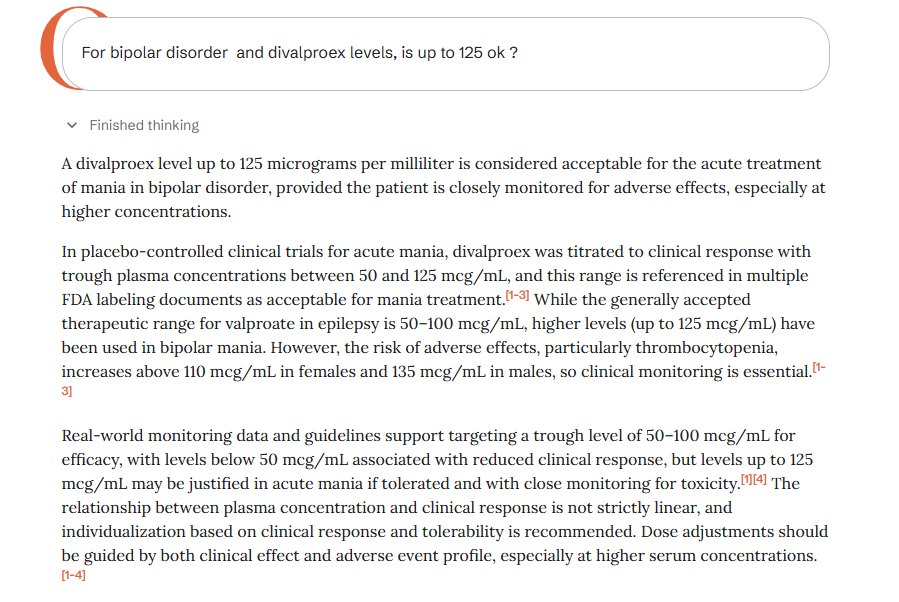
Open Evidence and Divalproex up to 125

Acceptable but should be monitored

Finished thinking

Bowden CL, Janicak PG, Orsulak P, et al. Relation of Serum Valproate Concentration to Response in Mania. The American Journal of Psychiatry. 1996;153(6):765-70. doi:10.1176/ajp.153.6.765. PMID: 8633687 is the citation by Dr. Charles Bowden from the mid-1990s specifically addressing divalproex in bipolar disorder. [1]
This study demonstrated that acutely manic patients treated with divalproex who achieved serum valproate levels between 45 and 100125 micrograms/mL were more likely to have efficacious and well-tolerated responses, while adverse effects were disproportionately associated with levels ≥125 micrograms/mL.

1.
Relation of Serum Valproate Concentration to Response in Mania.
Bowden CL, Janicak PG, Orsulak P, et al.
The American Journal of Psychiatry. 1996;153(6):765-70. doi:10.1176/ajp.153.6.765.

Post by Michael Okun on X. New drug for. L B D

YPbCAmgI_normal.jpg spacer.png
Michael Okun
⁦‪@MichaelOkun‬⁩
logo_twitter-1497383721365.png
spacer_464x1-1582829598167.png
A new drug has shown promise for Dementia with Lewy Bodies in the just released data from the SHIMMER (CT1812) trial. The data just released revealed that participants taking CT1812 performed better across measures of behavior, function, cognition, and movement. The treatment was… pic.twitter.com/Tr1ajZQGTO
12/19/24, 9:34 AM

Joseph Thornton

Post by Nutrition Science on X. Glp1 drugs scope

saFmfuz-_normal.jpg spacer.png
Nutrition Science
⁦‪@NutrioSci‬⁩
logo_twitter-1497383721365.png
spacer_464x1-1582829598167.png
Are GLP-1 drugs really for everybody? ⁦‪@NatureMedicine‬⁩ #MedEd #MedX #obesity #GLP1

“How genetic, clinical and sociodemographic differences impact their effects on weight loss.”

Open Access
nature.com/articles/s4159… pic.twitter.com/LGnfR3SdbC

12/3/24, 3:46 AM

Joseph Thornton

Post by Beverly G. Tchang, MD on X. Obesity grand rounds

TpdvrnZv_normal.jpg spacer.png
Beverly G. Tchang, MD
⁦‪@BevTchangMD‬⁩
logo_twitter-1497383721365.png
spacer_464x1-1582829598167.png
Looking for an intro on the State of #Obesity #Medicine?

Check out my ⁦‪@WeillCornell‬⁩ Medicine Grand Rounds

drive.google.com/file/d/10tKQwx…

I discuss:

👉What makes obesity a disease?
👉How do genetics and environment cause obesity?
👉How do we use on- and off-label anti obesity… pic.twitter.com/edj00tCSAW

10/13/23, 6:32 AM

Joseph Thornton
